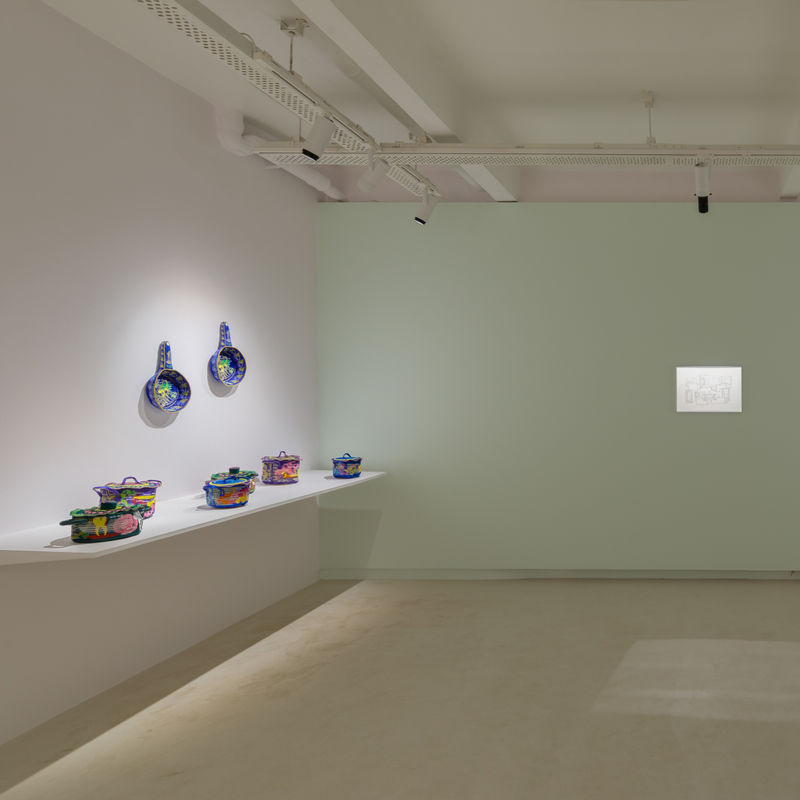
Staging the Chorus
Shimul Saha’s exhibition, 'Staging the Chorus,' brings together drawings, sculptures, fabric works, video installation, cyanotype prints and spatial interventions that examine how meaning is produced under conditions of proximity, circulation, and collective attention. The exhibition resists thematic resolution. Instead, it is organised through relations—between forms, materials, scales, and invisible bodies—allowing meaning to emerge through making rather than declaration.
His practice unfolds across mediums without hierarchy. Architectural line drawings, restrained and precise, appear alongside ceramic, fabric works and sculptures marked by colour, surface, and material insistence. Images oscillate between contemplation and consumption, between singular form and repeated signal. Meaning does not reside in the object alone but is generated through encounter, comparison, and duration.
In this exhibition, the gallery is treated as an operative environment rather than a neutral container. Movement through the space becomes a form of orientation, shaped by placement, visibility, absurdity and alignment. Viewers encounter works sequentially and peripherally, often aware of multiple pieces at once. Attention is split, redirected, recalibrated. In this sense, the exhibition mirrors conditions in which perception is managed not through instruction but through spatial arrangement.
The “chorus” functions here as a working model. No single work assumes authority but also reflects our collective condition in our shared reality. Each gains legibility through adjacency and difference, producing a polyphonic structure that resists singular voice or central command. The exhibition does not seek agreement. It sustains coexistence. Meaning is negotiated across fragments, through overlap and friction, rather than delivered intact.
Saha’s long engagement with exhibition-making—as an artist, curator, and educator—shapes this sensitivity to how works are constructed, circulated, and received. His practice reflects an awareness that visibility is never neutral: it is distributed, withheld, intensified, or diluted through spatial and institutional decisions. Along with staging critique through representation, Saha embeds these questions within the organisation of the exhibition itself—how access is shaped, how attention is directed, and how participation is structured. In this staging of his work, he also questions the perceived freedom of art and its relationship with economic access.
Architecture enters Saha’s work as an infrastructure of thinking rather than an image to be depicted. His drawings often begin with elemental spatial cues—frames, thresholds, grids, corridors—suggesting systems that order movement while remaining incomplete. Sculptural works extend these concerns into three dimensions, testing how objects regulate passage, claim territory, or leave space open. Architecture is procedural. It operates through orientation, containment, and release.
In his practice, space is increasingly understood as a medium through which behaviour is shaped. Saha’s installations operate within this understanding. Compression and openness, repetition and pause, produce shifts in awareness that implicate the viewer’s body. Looking becomes inseparable from standing, waiting, moving, and adjusting position. The exhibition asks not only what is seen, but how one is positioned in relation to what appears.
While Saha’s work draws from architectural modernism, popular culture, and the visual economies of consumption, it resists nostalgia and avoids direct critique. Delicate drawings that suggest idealised or speculative structures coexist with exuberant sculptural forms that echo saturation and excess. These juxtapositions reflect a condition in which order and overflow exist simultaneously, neither cancelling the other. The works do not resolve this tension; they hold it in place.
Staging the Chorus proposes the exhibition as a site of continuous shared negotiation. In an era marked by the relentless circulation of images and the commodification of attention, the exhibition insists on the political significance of sustained looking, especially when looking becomes difficult. The works neither mourn nor celebrate this condition; they hold it in suspension. What emerges is not consensus, but a shared condition of being together, attentive, and unresolved.
Shimul Saha lives and works in Dhaka, Bangladesh.
Arijit Bhattacharyya
Arijit Bhattacharyya
